
Blog

Two black lines meet opposite sides of a shared red frame and continue with equal visual weight.

The person who builds the budget often gets more than an administration job.

They decide which numbers appear, how uncertain costs are estimated, what counts as essential and when the answer is “we can’t afford that.” Even with good intentions, the spreadsheet can give one person more authority.

The other person may have less voice. They may also be able to avoid part of the responsibility: “You handle the money; just tell me what I can spend.”

Neither role is especially fair. Both can become exhausting.

A budget contains judgement, not only arithmetic

Two people can agree on the bank balance and still disagree about the plan.

Is travel to see family essential or optional? How much should remain as breathing room? Is one income estimate cautious or pessimistic? Does a cheaper choice create more unpaid work for somebody else?

The builder answers these questions every time they choose a category, assumption or forecast. If those decisions remain invisible, a household judgement can appear to be a mathematical fact.

“The spreadsheet says no” sometimes means “the assumptions we are currently using lead to no.” That is worth saying accurately.

Share visibility before sharing every task

Fairness does not require both people to enjoy spreadsheets or split every money task exactly in half.

It does require that each affected person can see:

  • the main income and cost assumptions;
  • what is confirmed and what is estimated;
  • which decisions are already committed;
  • what room remains and why;
  • who is responsible for the next action; and
  • when the plan will be reviewed.

One person may still maintain the detail. The process can still belong to both.

Give each person a separate first voice

Before looking at the finished budget, ask each person to write three things privately:

  1. one cost they believe must be protected;
  2. one pressure point they are worried about; and
  3. one change they are willing to explore.

Compare the answers before editing the numbers.

This helps prevent the more confident spreadsheet user from defining the entire agenda. It also asks the less involved person to bring judgement and responsibility, not only approval or complaint.

Keep assumptions open to challenge

Name important estimates. Instead of entering one number for groceries, childcare or variable income and treating it as truth, record where it came from and when it will be checked.

When people disagree, duplicate the scenario. One version can use the more cautious assumption; another can use the alternative. The Possibility Calculator supports scenario duplication, and invited sharing can give another person view or edit access within the relevant group.

The comparison may reveal that the disagreement barely changes the outcome. Or it may show that one assumption carries the whole decision.

The tool should make the conversation more visible. It should not decide who wins it.

Share responsibility without creating surveillance

A shared budget is not permission to monitor every purchase, demand justification for ordinary personal spending or remove another adult’s access to money.

Agree on the level of detail that is genuinely useful. Consider personal spending amounts that each person can use without line-by-line approval. Record who will pay which bills, check which balances or make which calls.

If one person controls money, accounts, work or access as a way to frighten or restrict the other, this is not a budgeting-style problem. Seek specialist support from a safe device. In New Zealand, Are You OK and Women’s Refuge provide information and support routes.

Change the meeting, not only the spreadsheet

Use a short review with a simple order:

  1. What changed since last time?
  2. Which assumptions were wrong or incomplete?
  3. What decision belongs to both people?
  4. Who owns each next action?
  5. When will we look again?

The person who creates the budget may still do more of the technical work. But they should not have to carry every decision, and technical confidence should not become private authority.

A useful shared budget makes power and responsibility easier to see—and gives both people a credible way to participate.

Practical Action

Hold a 20-minute budget reset. Each person arrives with one protected cost, one concern and one possible change. Choose one assumption to compare in a duplicate scenario, then assign each follow-up action by name and date.

This article provides general relationship and planning information, not personalised financial, legal or safety advice.

This entry was posted in people and relationships by Stephen Baugh
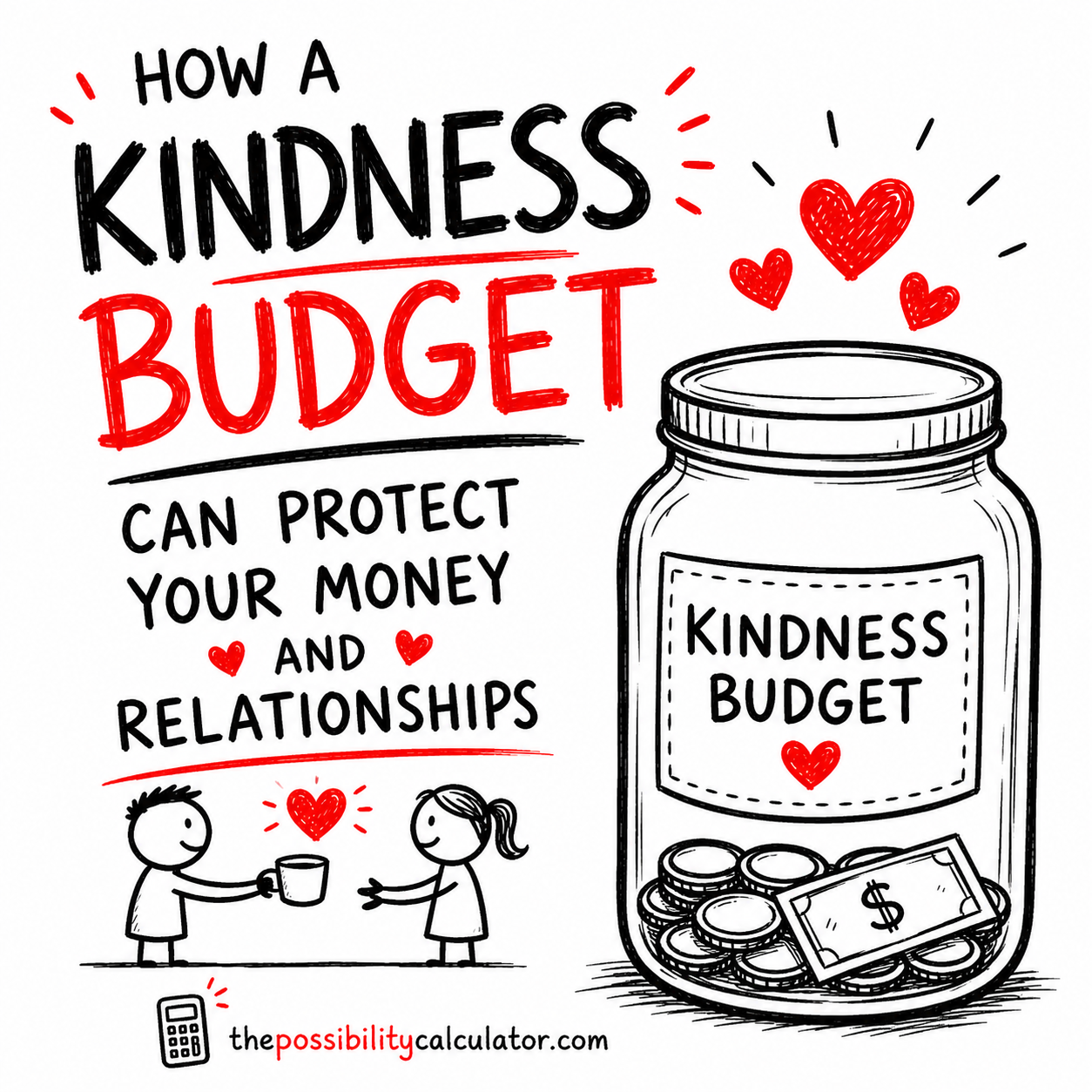
Most budgets have a line for power, food, rent, fuel and subscriptions.

Far fewer have a line for kindness.

But kindness often costs something.

It might be the extra groceries you buy when someone comes over. The petrol from always being the person who gives lifts. The small amount you send to an adult child. The meal you cover when a friend is having a hard week. The birthday present that becomes a little bigger because you know someone needs cheering up.

None of these are bad things.

In fact, they may be some of the best things money can do.

The problem is not generosity. The problem is invisible generosity.

If you quietly spend $35 a week helping people, hosting people, feeding people or covering little gaps, that becomes $1,820 over a year.

That number is not a reason to stop being kind.

It is a reason to decide on purpose.

A kindness budget might sound cold at first. But it can actually make generosity warmer, because it removes some of the hidden tension.

Instead of saying yes and then feeling anxious later, you can say:

“We’ve got a bit of room this month, so yes.”

Or:

“I can’t help with money right now, but I can bring dinner over on Thursday.”

Or:

“We’ve already used our helping-money for the month, so I need to be careful.”

That is not selfish. That is honest.

When kindness has no boundary, it can quietly turn into resentment. When every yes comes from the same money that was meant for bills, savings, debt repayment or rest, even good-hearted giving can start to feel heavy.

A visible kindness budget protects more than money.

It protects relationships from guesswork. It protects your future self from quiet panic. It protects your ability to keep helping without becoming exhausted. It helps you notice the difference between generosity and pressure.

And sometimes the most generous thing is not money at all.

It might be time. A cooked meal. A school pick-up. A phone call. A practical introduction. A quiet walk with someone who needs to talk.

If your numbers show that you genuinely do not have room to help financially right now, that does not make you unkind. It may simply mean this is a season for different kinds of support. And if the situation has moved beyond ordinary pressure into real financial hardship, it may be worth starting with the financial hardship resources rather than trying to carry everything quietly.

The point is not to turn love into a spreadsheet.

The point is to stop pretending love has no cost.

Because once you can see the cost, you can make better choices. You can decide what kind of generosity is sustainable. You can talk about it before resentment arrives. You can build a life where helping others is part of the plan, not a hidden leak in the background.

What if one small budget line helped you become not less generous, but more peacefully generous?

You might be surprised what becomes possible when you explore your own numbers in The Possibility Calculator.

This entry was posted in people and relationships by Stephen Baugh

couples and money, household budgeting, financial visibility

Sometimes the biggest money arguments begin before anyone spends a dollar.

The same money quietly gets given two different jobs.

One person looks at the bank account and thinks, “Good, we can finally start putting something aside for that holiday.”

The other person looks at the very same balance and thinks, “Good, we can finally replace the tyres.”

No one is being reckless.

No one is hiding anything.

But the same $120 a week has quietly become two different futures.

That’s how money tension starts in a lot of homes.

Not with a dramatic argument.

Not with a terrible financial mistake.

Just two people making private assumptions about shared money.

If there’s $120 left each week after the essentials, that feels encouraging. Over four weeks that’s $480. Over a year it’s $6,240.

That money could become:

  • a holiday fund
  • new tyres
  • school costs
  • an emergency fund
  • paying down debt
  • or simply a little more breathing room

They’re all good ideas.

The challenge is that the same money probably can’t do all of them at once.

This is where a budget becomes less like a spreadsheet and more like a conversation.

The useful question isn’t:

“What did you spend?”

Even when it’s well intentioned, that question can sound like an accusation.

A gentler question is:

“What should the next spare $100 do?”

That changes everything.

It moves the conversation away from blame and towards possibility. It uncovers assumptions before they quietly become resentment.

One person might say,

“I thought we were saving for the trip.”

The other might reply,

“I thought we were finally getting ahead on the car.”

Now you have something genuinely useful.

Not a fight.

Information.

Information is kinder than guessing.

That’s one of the reasons I built The Possibility Calculator. Not to tell people what to do, but to help make these conversations visible before assumptions quietly become disappointment.

This idea isn’t just for couples.

It applies to flatmates, shared parenting, adult children helping parents, families planning celebrations, business partners, or even friends who regularly spend money together without ever quite talking about what they can realistically afford.

Sometimes the most loving thing money can do is become visible.

Not controlled.

Not judged.

Just visible.

Of course, not every money conversation is this simple. If money is tied to control, fear, financial abuse, debt pressure or a genuine financial crisis, a conversation alone may not be enough. If that’s where you are, please be kind to yourself. You may find our Financial Hardship page helpful:

https://dashboard.thepossibilitycalculator.com/hardship

For many households, though, the first step is surprisingly small.

Take the next bit of uncommitted money and give it one job—together.

Not forever.

Just for now.

What if the next $100 wasn’t the beginning of tension, but the beginning of a shared possibility?

Try changing the numbers for your own situation in The Possibility Calculator and see what becomes possible.

https://www.thepossibilitycalculator.com/

This entry was posted in people and relationships by Stephen Baugh

A quick disclosure.

I’ve joked for much of my adult life that if I’m going to hell, it’ll probably be because of my spelling, grammar and proofreading.

I’m not diagnosed, but I’m fairly sure I have some level of dyslexia. Writing has never been the easy part for me. Thinking has.

So yes, I use AI.

I don’t use it to replace my ideas. I use it much like I would an editor sitting beside me. It helps me organise my thoughts, challenges my assumptions, fixes my spelling, improves my grammar and occasionally suggests a better way to explain something I’ve been trying to say.

The opinions on this site are mine.

The experiences are mine.

The stories are mine.

The mistakes are definitely mine.

AI simply helps me communicate them more clearly.

For this project in particular, you’ll probably notice AI has a bigger role than it does on some of my other websites.

The Possibility Calculator is a project I care deeply about, but like many side projects it has to fit around work, family and everything else life throws at us. I’d rather publish useful ideas regularly with the help of AI than wait for the mythical day when I have unlimited time.

That doesn’t mean I want to publish AI slop.

Quite the opposite.

Every article is something I review, edit and personalise. Sometimes AI gives me a starting point. Sometimes it helps me rewrite something I’ve already written. Sometimes it simply reminds me of another angle I hadn’t considered.

If an article makes you think differently about money, relationships, work, family or the possibilities available to you, then it’s done its job.

That’s what I’m trying to create here.

Not financial advice.

Not a lecture.

Just thoughtful conversations, practical ideas and a tool that might help you explore the consequences of different choices.

If AI helps me do that better, then I think it’s worth using.

Hopefully you do too.

This entry was posted in announcements & tips by Stephen Baugh

Be clear, be confident and don’t overthink it.

This entry was posted in announcements & tips by Stephen Baugh